Note: This event happened in May 2018... this is (finally!) being posted in March 2022.
Photo of Ian with scope is from 2014!
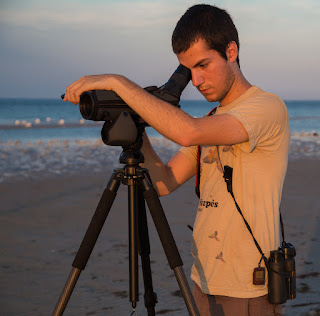
I am so proud that Ian has found a way to follow his passion, support himself well and live every day working toward the betterment of the birding world, doing what he loves best... birds! Since he was 11 he's been fascinated with seeing and hearing them, learning about their special behavior and traveling to find, observe and photograph more birds. The fact of him seeing the most birds at one time than have ever been seen is the icing on the cake!
In an attempt to record this amazing event that happened in May of 2018 in Tadoussac, Canada, I thought I'd make a blog post about it so I can go back and see it all in one place.
In an attempt to record this amazing event that happened in May of 2018 in Tadoussac, Canada, I thought I'd make a blog post about it so I can go back and see it all in one place.
Some of the published items about this day are below.
I'll start out with Ian's description of the over 9 hours of non stop birds flying by!
Link is here if you want to read more and see his excellent photos: https://ebird.org/view/checklist/S46116491


I'll start out with Ian's description of the over 9 hours of non stop birds flying by!
Link is here if you want to read more and see his excellent photos: https://ebird.org/view/checklist/S46116491
Mon May 28, 2018 5:45 AM
- Protocol:
- Traveling
- Party Size:
- 6
- Duration:
- 9 hour(s), 41 minute(s)
- Distance:
- 0.8 kilometer(s)
- Observers:
- François-Xavier Grandmont List , Ian Davies , Sarah Dzielski List , Thierry Grandmont List , Tim Lenz List , Tom Auer List
- Comments:
- [text by Ian Davies]
Today was the greatest birding day of my life.
Southwest winds overnight had led to high hopes for the morning, compounded by dawn rain in the area. Our first stop had been fruitless, with a handful of warblers moving, but nothing notable. We decided to head for the Tadoussac dunes anyways.
On our arrival (545a), it was raining. A few warblers passed here and there, and we got excited about groups of 5-10 birds. Shortly before 6:30a, there was a break in the showers, and things were never the same.
For the next 9 hours, we counted a nonstop flight of warblers, at times covering the entire visible sky from horizon to horizon. The volume of flight calls was so vast that it often faded into a constant background buzz. There were times where there were so many birds, so close, that naked eyes were better than binoculars to count and identify. Three species of warbler flew between my legs throughout the day (TEWA, MAWA, MYWA). For hours at a time, a single binocular scan would give you hundreds or low thousands of warblers below eye level.
The flight line(s) varied depending on wind direction and speed. All birds were heading southwest. When calm, birds were high, often inland or farther out over the river. High winds (especially from the W, or SW), brought birds down low, sometimes feet from the ground and water. Rain also lowered birds, and the most intimate experiences with migrants occurred during a rain squall and strong wind period. Hundreds of birds stopped to feed and rest on the bare sand, or in the small shrubs.
Counting birds and estimating species composition was the biggest challenge of the day—balancing the need to document what was happening with the desire to just bask in the greatest avian spectacle I’ve ever witnessed. A significant effort was made to estimate movement rates throughout the day, and those rates combined with species-specific movement estimates were used for the below totals. See the full checklist for species-specific notes.
Movement rate estimates were made by looking through binoculars at a flight line, and counting the number of individuals passing a vertical line in that field of view, per second. This was repeated multiple times for each bin view, and repeated throughout the sky so that all flight at that moment was accounted for. The average birds/second was then used for that time period, until another rate estimate showed a different volume of movement. Non-warblers were counted separately. I took a couple attempts at video, which are listed below under ‘warbler sp.’ These videos only hint at the magnitude of the spectacle.
These were my warbler rate estimates:
6:29-6:43 8/s — 6720
6:44-7:02 3/s — 3240
7:03-7:14 15/s — 9900
7:15-8:02 30/s — 84600
8:03-8:27 10/s — 14400
8:28-9:12 15/s — 48600
9:13-9:31 12/s — 12960
9:32-9:48 15/s — 14400
9:49-1038 25/s — 73500
10:39-11:03 40/s — 57600 (during and after a rain squall)
11:04-11:52 30/s — 86400
11:53-12:17 20/s — 28800
12:18-12:37 15/s — 17100
12:38-12:48 25/s — 15000
12:49-1:13 50/s — 72000 (winds switch to strong WSW)
1:14-2:36 30/s — 147600
2:37-2:56 20/s — 22800
2:57-3:04 10/s — 4200
3:05-3:14 3/s — 1620
3:15-3:18 1/s — 180
Total number of warblers: 721,620
To our knowledge, the previous warbler high for a single day in the region was around 200,000, which was the highest tally anywhere in the world. Other observers in the area today had multiple hundreds of thousands, so there were likely more than a million warblers moving through the region on 28 May 2018. Thank you to the Observatoire d’Oiseaux de Tadoussac (http://www.explosnature.ca/oot/) for monitoring these movements for decades, and sharing the wonder of this place with the global birding community.
There’s no place like Tadoussac.
- Submitted from eBird for iOS, version 1.7.4
Species
108 species (+3 other taxa) total
And the New York Times wrote a great article about this astonishing day:
https://www.nytimes.com/2018/05/31/science/warblers-canada-migration.html
You'll see more great images if you go to the eBird link and scroll down
A Canada warbler.
Photo Credit
Ian Davies
Article By James Gorman
- May 31, 2018 New York Times
Ian Davies got hooked on birds when he was 12. He went to a site near Plymouth, Mass., where volunteers were putting bands on migrating birds.
“They let me release a Canada warbler,” he said, “and that was just game over.”
On Monday, he saw an estimated 700,000 warblers and set the birding world all atwitter with a posting on the site eBird describing the astonishing event.
The posting begins simply:
“Today was the greatest birding day of my life.”
He may one day top it, because he is 26. But he has a good deal of experience to look back on already. In 14 years of dedicated birding, he has been to 35 countries, and is a project coordinator of eBird, a citizen science project for gathering data from the worldwide community of birders, who contribute data on about 100 million sightings a year.
He and his fellow birders were at the Tadoussac bird observatory in Quebec, on the north bank of the St. Lawrence River. Pascal Côté, the director of the observatory who has been monitoring birds there for 10 years, said “I have never seen anything like this.” His group, at a different location in the same area, saw 200,000 birds in what was only one part of a miles-wide corridor. He said he thought the total was probably closer to 500,000, but could be higher.
It was, in any case, ten times as many as he had ever seen in a day, and, he thought, the most passerines, or perching birds, ever seen in one day in North America.
Mr. Davies’ method for counting was to calculate the rate of passage of birds across an imaginary line at different points through the day for a few seconds and extrapolate. Mr. Côté’s team counted birds at their spot with a different approach, trying to tally the actual numbers, not one by one, but in blocks. An observer might count out 10 or 50 or 100.
It was a personal trip for Mr. Davies. “We were chasing something like this,” he said yesterday in a phone conversation, still at Tadoussac, still observing and counting birds. “Our wildest hope was to have one day with 50,000 warblers.”
“As far as we’re aware,” he said, “it’s three times the number of warblers that anyone has ever seen at a location anywhere. It was basically a river of warblers. All heading southwest.” The previous record was 200,000.
These are northward migrating birds, but frequently at Tadoussac, there is a huge morning flight of warblers who have overshot the mark or have been blown off course and are heading back to known food sources before continuing on.
The morning started off quiet, he said, and then the birds just kept coming. They did not quite darken the sky as passenger pigeons once did. But the group was stunned because they kept coming for nine hours.
They had to calculate the rate at which the birds were passing rather than count individuals and Mr. Davies said, “It felt sort of like a dream. How do you communicate what that dream was like to others.”
There were more than 100,000 each of Cape May Warblers, Bay Breasted warblers and Tennessee warblers.
Like the rest of the world, birders use Twitter, and they tweeted in delight:
Like the rest of the world, birders use Twitter, and they tweeted in delight:
Have you ever seen 100k Cape May warblers in a day? This person has, and it’s just the beginning of a mind-blowing day:
eBird Checklist – Observatoire d’Oiseaux de Tadoussac - Dunes, La Haute-Côte-Nord County, Quebec,...
This checklist is RIDICULOUS!!!!!
I have to go to this place next year. Being able to see this many birds in one place must have been overwhelming.
Over 700,000 warblers! Look at this!!
eBird Checklist – Observatoire d’Oiseaux de Tadoussac - Dunes, La Haute-Côte-Nord County, Quebec,...
Good. God. This. EBird list.
The reason for the large number, Mr. Davies speculated, was that these are birds that eat the larvae of the spruce budworm, and their populations explode when the budworm numbers go up.
He is not sure how he is going to top this day and joked, “I need to find a new hobby.”
************************************************************************************
From one of Ian's homeschool friends we grew up with... thanks for the great words, Jeff!
http://archive.is/XkFr3

Huge congrats to Ian Davies for being the first of my childhood friends to not only get quoted in the New York friggin times, but to be profiled by the paper! You're an inspiration for everyone who wants to follow their passion, and I'm super proud that you've built a life around your love of birding.
http://archive.is/XkFr3

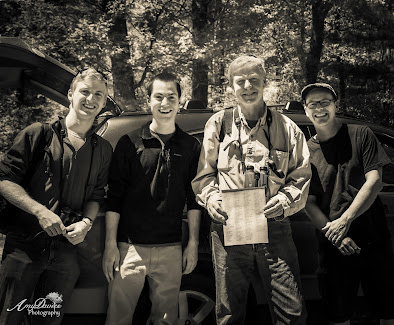
From Left to right: Luke, Ian, Peter, Tim on a big day of birding in MA May 2015






 Posts
Posts


